 Sustainability Annual Report 2025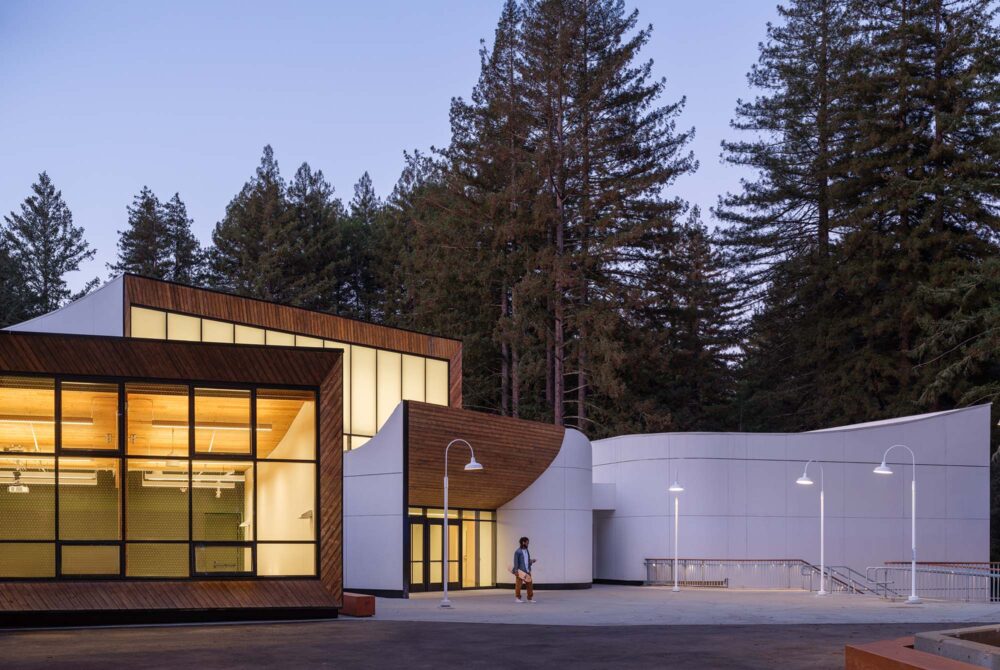
Climate Change, Sustainability and Resilience is one of the five pillars in Leading the Change, the campus-wide strategic plan UCSC completed in 2022.
A plan goal is to decarbonize UC Santa Cruz to create an equitable, accessible and fossil-free future.
Read More about Sustainability at UC Santa Cruz
UCSC has made strong progress toward this goal. The Kresge College renewal includes the campus’s largest all-electric academic and residential facility. UCSC has launched a major project to reduce natural gas use in its central heating and hot water systems. Grounds crews are transitioning from gas to electric-powered equipment. Design work has been completed for several campus microgrids — self-sufficient energy systems that support energy resilience and sustainability.
To advance conservation, teaching and research, UCSC and The Conservation Fund announced a collaboration that will conserve more than 200 acres of currently privately held land adjacent to the residential campus. In addition, the campus is pursuing a transformative plan to expand UCSC’s research and education in sustainable organic agriculture through the acquisition of another 200-plus acres of private farmland that borders its coastal campus.
Additional accomplishments include:
- Launch of the Joint Academic Senate/Administration Committee on Climate Change, Sustainability and Resilience to advance teaching, research and operational goals.
- Adoption of the Okanagan Charter, also known as Health Promoting Universities (UCSC is one of nearly 30 institutions of higher education around the nation to do so).
- Award of the 2025 Integrated Pest Management Achievement Award to the Grounds Department by the California Department of Pesticide Regulation.

Stories

Chancellor’s 2024 Innovation Awards Honor Excellence in Research and Impact
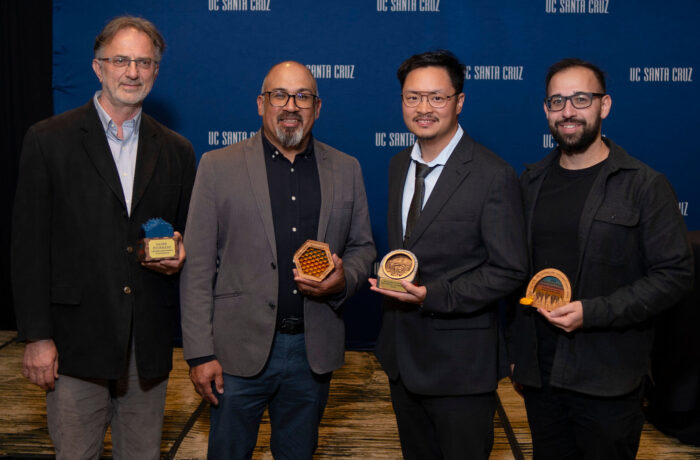
Jason Eshraghian, a UC Santa Cruz assistant professor of electrical and computer engineering, and his research team, received the University’s Innovator of the Year Award. The team developed a computing approach that eliminates energy-intensive generative AI technologies, achieving comparable performance while consuming just 13 watts — roughly the power of a household light bulb. Their method underpins SpikeGPT, a spiking neural network for language generation that activates only when stimulated, greatly reducing energy use.
Research Project Shows How Aquaculture, Agriculture, and Restoration Can Work Together
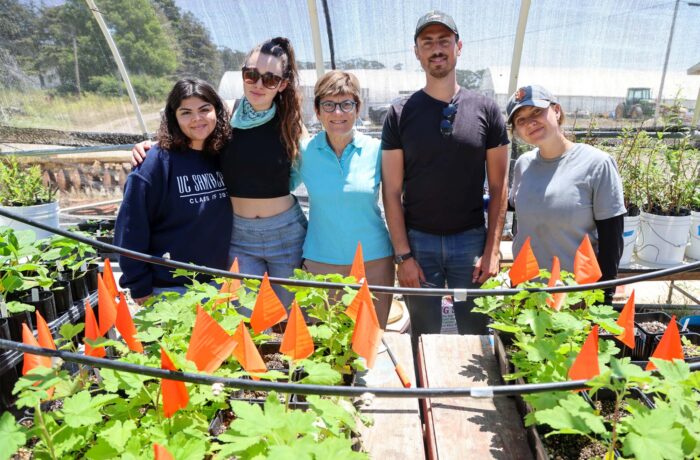
UC Santa Cruz Professor Anne Kapuscinski led a collaboration with Pie Ranch and the Amah Mutsun Land Trust to repurpose backwash, filtered water from aerated, recirculating aquaculture systems housing 200 rainbow trout, to irrigate native plants. Researchers are investigating why this nutrient-rich water promotes plant growth. Select plants are being used to replace invasive eucalyptus trees and to restore landscapes burned in the 2020 CZU Lightning Complex Fire.
EMISSIONS
*Methodological changes in scope 3 accounting introduced beginning in 2019
**90% direct reduction of total emissions from 2019 levels with residual emissions negated by carbon removal
UCSC’s scope 1 emissions decreased in 2024, but the reduction is primarily attributed to less heating due to warmer temperatures. Although UCSC has reported scope 3 emissions from commutes and air travel in the past, this was the first year the campus included scope 3 emissions from solid waste and other business travel like rental cars and personal mileage reimbursements.
ENERGY – RENEWABLE ENERGY USE
ENERGY USE INTENSITY (EUI)
UC Santa Cruz saw an increase in its EUI in the calendar year 2024 as the campus increased density within existing residential facilities and academic buildings. Concurrently, UCSC is advancing its long-term building performance strategy through persistent commissioning, data analytics and utility partnerships to address inefficiencies and reduce EUI across the campus in future years.
FOOD

of food and beverage purchases met sustainability criteria ($1.1M)
of food and beverage purchases were plant-based ($3.5M)
There was a large rise in cost of animal proteins due to factors like the avian flu outbreak and the shift to higher-quality products through partners like Real Good Fish and Cream Co. This caused plant-based spend to decrease as a percentage of total spend, even though the amount of animal protein purchased actually decreased.
Green building
Three buildings were constructed, occupied, and received their LEED rating in 2025: Rachel Carson College Dining, Kresge Academic Building and Kresge Residential Halls.
10 Gold, 8 Silver and 2 Certified
Total number of LEED certifications
Healthy Vending

healthy vending spend on food ($57K)

healthy vending spend on beverages ($37K)
Healthy vending is defined as meeting UC’s Healthy Vending Guidelines. Data is from 2023–24.
Approximately 50% of food and 18% of beverages met healthy vending criteria. The campus’s MeFit vending machines include beverages and snacks. Beverage metrics include data from Pepsi and MeFit. Since MeFit did not provide cost data, the campus used averages from other data sets to estimate percentages.
procurement
The University reports on green spend, as defined in the Sustainable Procurement Guidelines, and reached out to suppliers for spend data in four product categories for this year’s report.

green spend on electronics (88%)

green spend on indoor office furniture (87%)

green spend on cleaning supplies (73%)

green spend on office supplies (14%)
Green spend is defined as meeting preferred or minimum criteria in UC’s Sustainable Procurement Guidelines.
Suppliers reporting: Electronics (7), Furniture (4), Cleaning supplies (3), Office supplies (4).
UC Systemwide Spend Analytics category data provided by CalUSource.
Sustainable Building & Laboratory Operations

total assessed green laboratories
The Green Labs team recertified two labs, certified 15 new labs and provided thousands of dollars in incentives for freezers and fridges.
Transportation
UCSC has focused on the installation of electric vehicle charging this year and will bring on multiple new ports to support the purchase of additional zero-emission vehicles next year.

of students and employees are utilizing sustainable commuting methods

of all vehicles and 25% of sedans and minivans acquired in 2025 were sustainable vehicles*
17%
of the fleet consists of sustainable vehicles*

EV charging ports
Sustainable vehicles are defined as electric (zero-emission), plug-in hybrid or clean transportation fuel
WATER
*Based on a 3-year average of fiscal years 2005-08
**2025 goal is a 36% reduction from baseline.
UCSC achieved the University’s 2025 water reduction goals. Water use increased this year due to weather-related irrigation needs, new irrigation needs related to new construction, an increase in makeup water usage at the pool related to a malfunction with the effluent sensor, and shutdowns and issues in the two main cogeneration cooling towers that forced reliance on a third cooling tower that is less efficient.
ZERO WASTE – GENERATION
*These numbers might include a small amount of incineration that is being phased out.
**In 2021, waste generation per weighted campus user spiked due to pandemic-related closures as base-level operations continued but the number of users on campus decreased.
The campus’s generation rate improved to 0.84 pounds per person per day, which is very close to the 2025 goal of 0.82. Total municipal solid waste generation decreased from the previous two years and is 7% below the lowest pre-COVID total municipal solid waste generation number. These improvements are likely due in part to deployment of organics containers and increased educational efforts.
ZERO WASTE – DIVERsion
*Waste incineration was counted as diversion prior to July 2022.
The diversion rate without construction and demolition remained relatively steady. Efforts to enhance diversion over the past year included adding organics bins to all dumpster locations, expanding the number of buildings with three-bin systems and taking initial steps toward centralized bins, and the Custodial and Grounds teams (waste collection operations) combining under common leadership. Sustainability staff have worked closely with custodial staff on improved handling of materials.
Single-Use Plastics Phase-Out
Complete Phase-out*
- Plastic bags
Partial Phase-out
- Foodware (UC dining facilities)
- Foodware (third-party dining facilities)
- Beverage bottles (UC dining facilities)
- Beverage bottles (vending machines)
Starting Soon
- N/A
*Complete phase-out of single-use plastics may include exemptions where reasonable alternatives to plastic do not exist.
UCSC has completely phased out single-use plastic bags and is in the process of phasing out single-use plastic non-water bottles and catering serviceware.
Awards
UCSC maintains a STARS Gold rating.
A full list of awards is featured on the UC Office of the President’s website.