 Sustainability Annual Report 2025
UC Agriculture and Natural Resources (UC ANR) delivers the land-grant mission for UC and California by developing and promoting practical, science-based solutions in agricultural production and food systems, natural resources management, ecosystem resilience, community and youth development, and nutrition and health.
UC ANR operates 11 facilities statewide: 10 Research and Extension Centers (RECs) and a central administrative building in Davis. Of these, one is LEED certified, and two new building projects at REC sites are designed to achieve LEED Gold certification. UC ANR personnel are also located at nine UC campuses and 59 county offices, serving all 58 counties in California.
Read More about Sustainability at UC Agriculture and Natural Resources
UC ANR builds sustainability practices into work both on-site and in California’s communities. When UC ANR evaluates procurement options, 15% of the criteria for selection relates to sustainability goals. Aligned with UC’s zero waste goals, UC ANR is piloting centralized waste streams in the Davis building. UC ANR academics lead green-certified labs at all five Agriculture Experiment Station campuses.
Between 2024 and 2025, UC ANR’s facilities reduced carbon dioxide emissions by 3.5%, from 875 to 844 metric tons, and increased natural gas use 0.7%, from 234 to 235 metric tons. Overall indirect greenhouse gas emissions, largely from purchased electricity, decreased by 9%. Potable water consumption stayed steady at about 16 million gallons. Hansen REC had a 258% increase in potable water consumption as operations ramped up at its new site. Across the other RECs, there was a 5.5% decrease in potable water use.
Stories
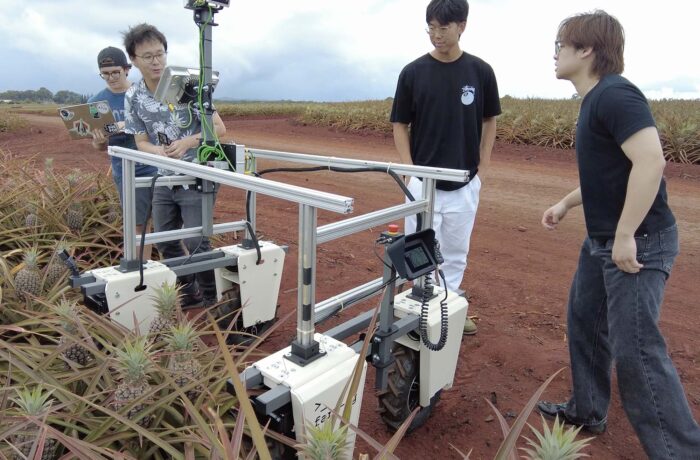

Students in Farm Robotics Challenge Develop Novel Technologies to Improve Agricultural Resilience
For the 2025 Farm Robotics Challenge, UC ANR and partners supported 20 collegiate teams to develop robot and drone systems that increase the resilience of an array of agricultural and working lands. Winners included a robotic platform that helps growers minimize water and chemical inputs from University of Georgia’s team and a robot-drone system that optimizes pineapple harvesting from the University of Hawai’i at Mānoa team. Winners also receive support to commercialize their inventions.

Cooperative Extension and Agriculture Experiment Station Researchers Develop AI-Powered Chatbot to Identify Weeds
About half the pesticides sold in California are applied in non-agricultural areas, targeting plant and animal pests in residential homes, gardens, schools and public landscapes. Being able to correctly identify weeds in non-agricultural settings supports the public to use fewer and less toxic solutions by tailoring treatment recommendations. WeedChat, an AI-powered chatbot developed by Agricultural Experiment Station faculty member Mohsen Mesgaran and Alireza Pourreza, a cooperative extension specialist at UC Davis, is a novel approach to help people do just that.
EMISSIONS
*Methodological changes in scope 3 accounting introduced beginning in 2019
**90% direct reduction of total emissions from 2019 levels with residual emissions negated by carbon removal
UC ANR had a reduction in scope 1 emissions from 875 to 844 metric tons. This was primarily due to a reduction in stationary fuel use from 592 to 556 metric tons.
ENERGY – RENEWABLE ENERGY USE
ENERGY USE INTENSITY (EUI)
UC ANR saw a decrease in its EUI in the calendar year 2024.
Green building
The number of green buildings remained unchanged from last year.
1 Certified
Total number of LEED certifications
Transportation

EV charging ports
The fleet remained unchanged from last year.
Water
UC ANR’s potable water consumption increased from 15.9 million gallons to 16.2 million gallons. This was largely due to the ramping up of operations at the new site of the Hansen Research and Extension Center (REC). Other RECs achieved a slight decrease in potable water consumption.

gallons of water used in 2025
Awards
A full list of awards is featured on the UC Office of the President’s website.